Provide global customers with the best e-liquid & nic salt & free base and the best service, all in Vape Hammer.

50/50 vs 70/30 VG/PG E-Liquid: What’s the Difference and Which Should You Choose?2026-09-23
50/50 vs 70/30 VG/PG E-Liquid: What’s the Difference and Which Should You Choose?
When choosing e-liquid, flavor and nicotine strength usually get most of the attention. But another specification on the product page can be just as important: the VG/PG ratio.
Two ratios you may often see are 50VG/50PG and 70VG/30PG.
Neither ratio is automatically better. They have different characteristics, and the more suitable option depends on the e-liquid, the device you plan to use and your personal preferences.
Understanding the difference can make it easier to compare products before ordering.
What Do VG and PG Mean in E-Liquid?
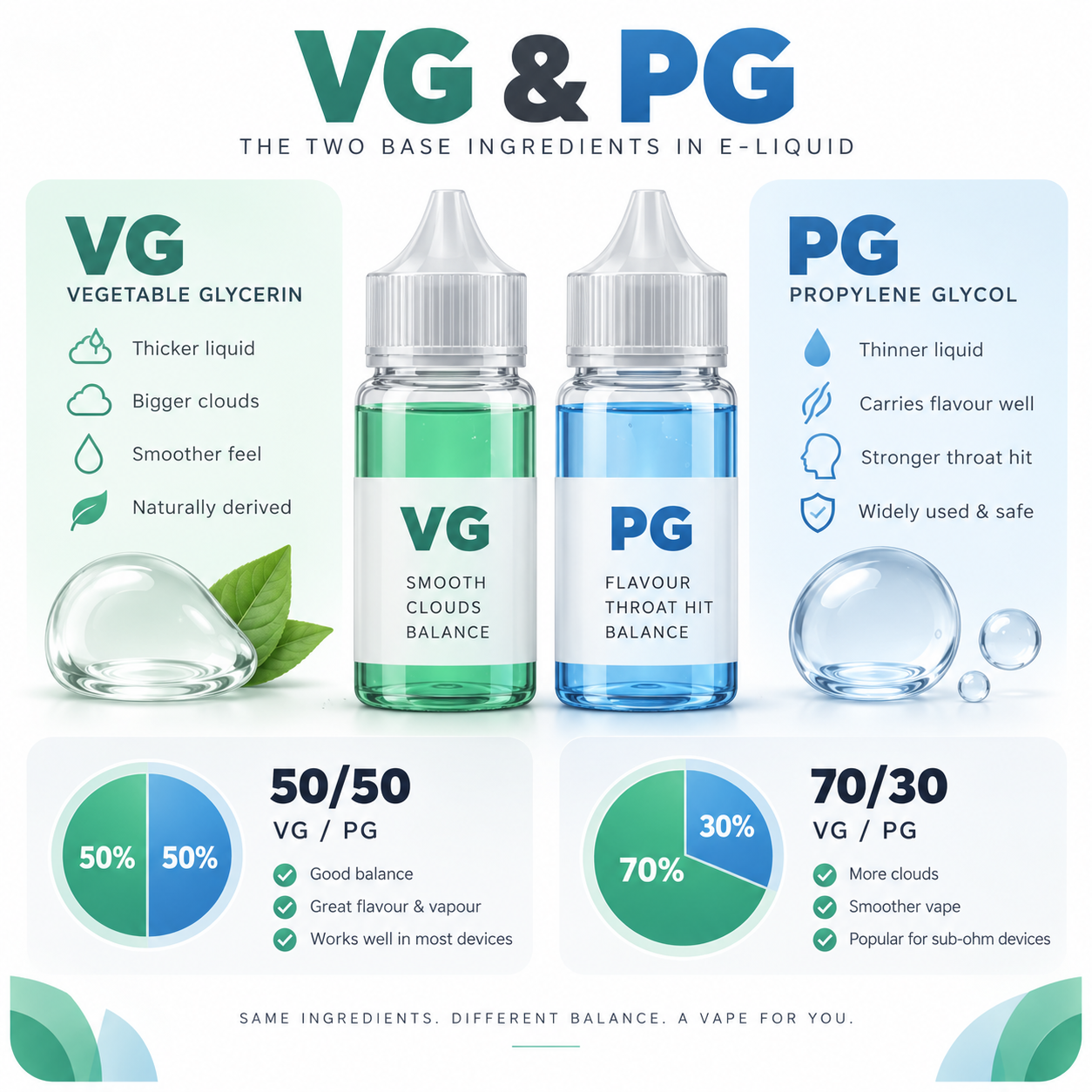
VG stands for Vegetable Glycerin, while PG stands for Propylene Glycol.
Both are commonly used as base ingredients in e-liquid. The ratio shows the relative amount of each ingredient in the liquid.
For example:
50VG/50PG means the liquid contains an equal balance of VG and PG.
70VG/30PG means the liquid contains a higher proportion of VG.
One of the most noticeable practical differences is consistency. Higher-VG liquids are generally thicker, while a higher proportion of PG results in a thinner liquid.
This difference matters because different vaping devices and coils may handle liquid thickness differently.
How Does 50/50 E-Liquid Compare with 70/30?
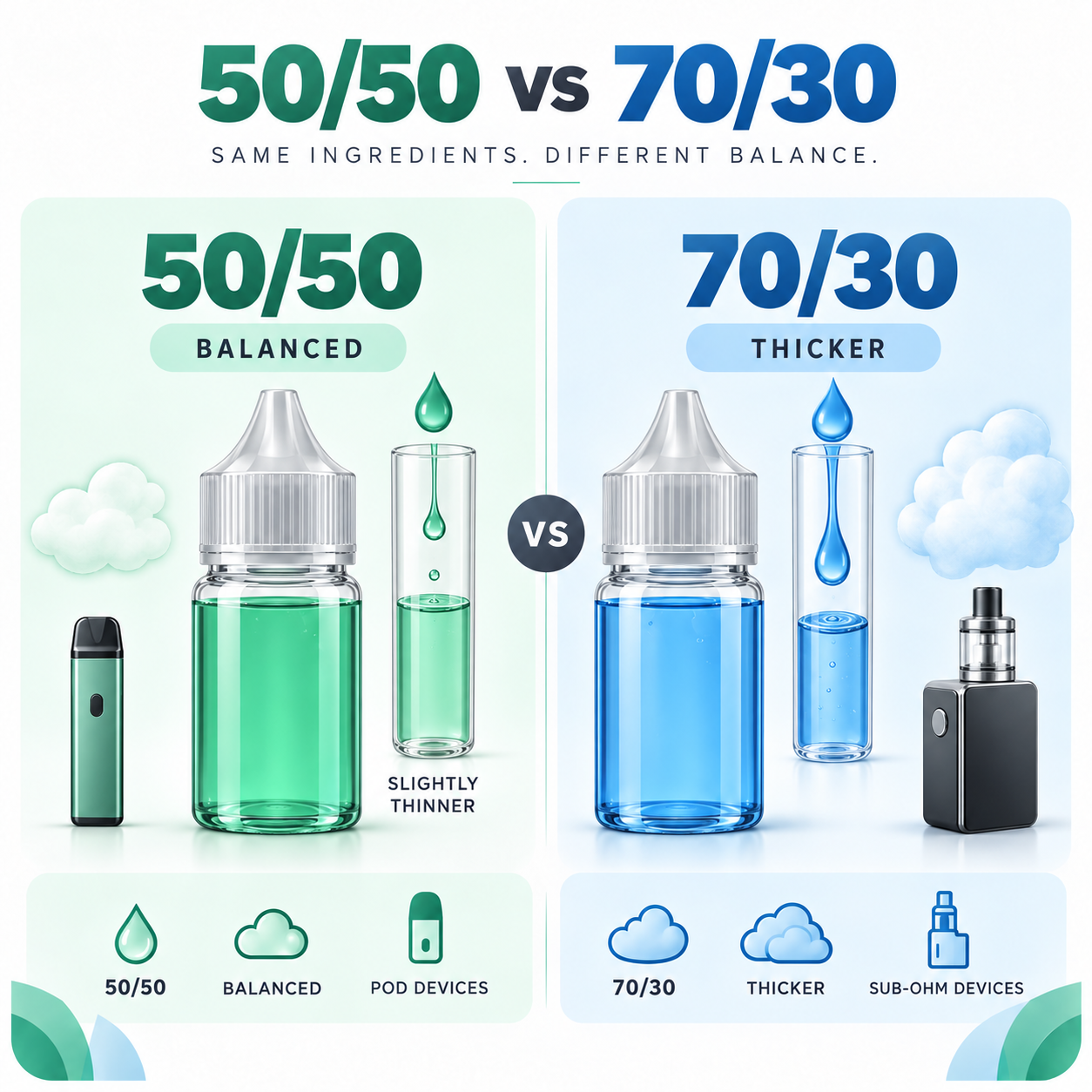
A 50/50 e-liquid provides an even balance between VG and PG.
Because it is generally thinner than a 70/30 blend, 50/50 liquid is commonly found in products intended for devices that use smaller coils or lower liquid flow.
A 70/30 blend contains more VG and is therefore usually thicker.
Many larger-bottle e-liquids and products intended for devices capable of handling thicker liquids use ratios around 70VG/30PG.
The main difference is therefore not simply the number on the bottle. The ratio can affect how easily the liquid moves through the device and how suitable it is for a particular coil or pod system.
Why Does Device Compatibility Matter?
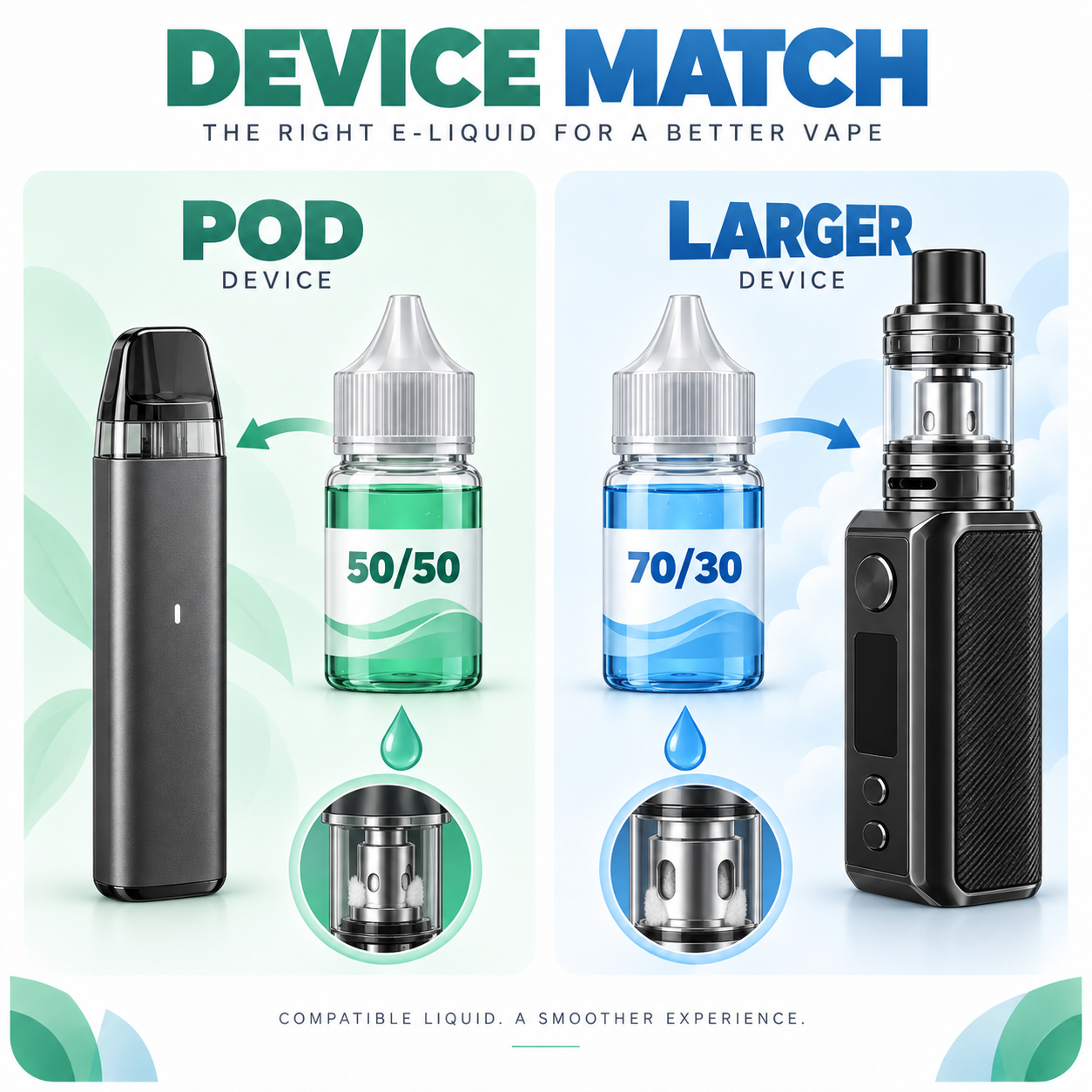
The VG/PG ratio should be considered together with the device you are using.
A small pod or compact device may be designed for a relatively thin liquid. In this case, a very high-VG liquid may not always be the most appropriate choice.
Larger devices with coils designed for greater liquid flow may be more suitable for thicker blends such as 70VG/30PG.
This does not mean that every pod requires 50/50 or that every larger device requires 70/30.
Device designs vary significantly, so the safest approach is to check the device manufacturer’s recommendations and the information provided on the individual e-liquid product page.
If you are unsure, compatibility is more important than simply choosing the VG/PG ratio that sounds more appealing.
Why Are Different E-Liquids Made with Different VG/PG Ratios?
Different e-liquid categories are often formulated for different types of devices and usage preferences.
For example, some nicotine salt products use balanced VG/PG ratios such as 50/50, while many larger freebase-style e-liquids use higher-VG ratios such as 70/30.
However, this is not a universal rule.
You may find nicotine salt products with other ratios, and the exact formulation varies between products.
That is why it is useful to check the actual specification rather than assuming the ratio from the bottle size, nicotine strength or product category.
At VapeHammer, individual product pages show the available specifications so customers can compare the flavor, nicotine strength, bottle size and VG/PG ratio before making a selection.
Should You Choose 50/50 or 70/30 E-Liquid?
Start with your device rather than choosing a ratio based only on preference.
Check what type of e-liquid the device is designed to use and what the manufacturer recommends.
Then consider the product you are interested in.
If the product is offered in 50VG/50PG, it is generally a more balanced and thinner formulation than a 70VG/30PG version.
If the product uses 70VG/30PG, it contains more VG and will generally have a thicker consistency.
The important point is that there is no single VG/PG ratio that is right for every customer or every device.
A suitable choice depends on the combination of your device, coil, e-liquid formulation and personal preferences.
VG/PG Ratio, Nicotine Strength and Bottle Size Are Separate Choices
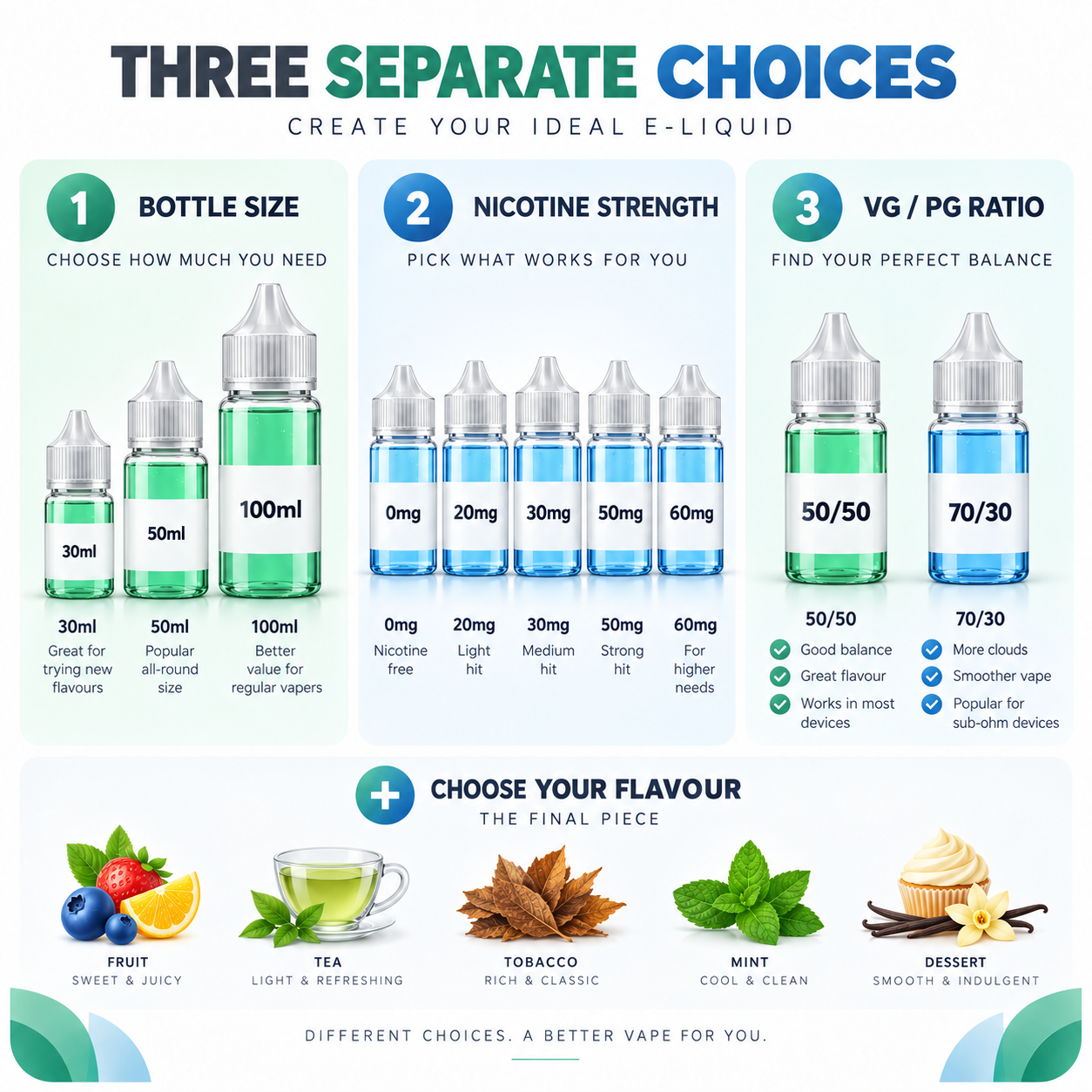
VG/PG ratio is only one part of choosing an e-liquid.
Bottle size tells you how much e-liquid you are purchasing.
Nicotine strength tells you the nicotine concentration.
VG/PG ratio describes the balance of the two main base ingredients.
For example, a 100ml e-liquid may be available in 0mg, 3mg or 6mg while using a 70VG/30PG base.
A different 30ml or 50ml product may use a 50VG/50PG ratio and offer another set of nicotine strengths.
These specifications should therefore be checked separately instead of assuming that one automatically determines the others.
Check Flavor, Strength, Size and VG/PG Together
A better way to choose e-liquid is to look at the complete product rather than focusing on a single specification.
First, choose a flavor profile that interests you, such as fruit, ice, tea, tobacco or dessert.
Next, check the available bottle sizes and nicotine strengths.
Then review the VG/PG ratio and make sure it is appropriate for the device you plan to use.
VapeHammer offers a range of e-liquid and nicotine salt products with different flavor, strength, bottle-size and VG/PG options. Customers looking for more flexibility can also explore Custom E-Liquid options where available.
Before ordering, always review the individual product specifications because VG/PG ratios, nicotine strengths and bottle sizes can vary between products.
Store e-liquid in a cool, dry place away from children and pets, and follow the laws and regulations that apply in your region.
- User Center
- Tracking Order
- Register
- My Orders
- My Account
- Terms & Conditions
- FAQ
- Payment & Shipping
- Payment Methods
- Shipping & Delivery

Copyright © 2026 VapeHammer. All Rights Reserved.